Policy Gradients
Let $\tau$ denote a state-action trajectory $\tau = (s_0, a_0, s_1, a_1, \ldots, s_H, a_H)$. We denote the reward of the trajectory as $R(\tau) = \sum_{t=0}^{H} R(s_t, a_t)$. The expected utitlity given a policy $\pi_\theta$ is:
$$U(\theta) = E [\sum_{t=0}^{H} R(s_t, a_t) \mid \pi_\theta] = \sum_{\tau} P(\tau \mid \pi_\theta) R(\tau)$$
Our goal is to find the policy $\pi_\theta$ that maximizes the expected utility $U(\theta)$:
$$\max_{\theta} U(\theta) = \max_{\theta} \sum_{\tau} P(\tau \mid \pi_\theta) R(\tau)$$
We want to perform gradient ascent on $U(\theta)$, but cannot generally backpropagate directly through sampled trajectories and their rewards. Changing $\theta$ changes the distribution of trajectories, so we use the log-derivative trick to estimate this effect from samples. Taking the gradient of the expected utility with respect to the policy parameters $\theta$, we get:
\[
\begin{align*}
\nabla_{\theta} U(\theta)
&= \nabla_{\theta} \sum_{\tau} P(\tau \mid \pi_\theta) R(\tau) \\
&= \sum_{\tau} \nabla_{\theta} P(\tau \mid \pi_\theta) R(\tau) \\
&= \sum_{\tau} \frac{P(\tau \mid \pi_\theta)}{P(\tau \mid \pi_\theta)} \nabla_{\theta} P(\tau \mid \pi_\theta) R(\tau) \\
&= \sum_{\tau} P(\tau \mid \pi_\theta) \frac{\nabla_{\theta} P(\tau \mid \pi_\theta)}{P(\tau \mid \pi_\theta)} R(\tau) \\
&= \sum_{\tau} P(\tau \mid \pi_\theta) \nabla_{\theta} \log P(\tau \mid \pi_\theta) R(\tau) \\
&= E_{\tau \sim P(\tau \mid \pi_\theta)}\left[ \nabla_{\theta} \log P(\tau \mid \pi_\theta) R(\tau) \right]
\end{align*}
\]
We can estimate the gradient by sampling trajectories from the policy:
$$\nabla_{\theta} U(\theta) \approx \frac{1}{N} \sum_{i=1}^{N} \nabla_{\theta} \log P(\tau_i \mid \pi_\theta) R(\tau_i)$$
We can do temporal decomposition on $\nabla_{\theta} \log P(\tau \mid \pi_\theta)$:
\[
\begin{align*}
\nabla_{\theta} \log P(\tau \mid \pi_\theta)
&= \nabla_{\theta} \log [ \prod_{t=0}^{H} P(s_{t+1} \mid s_t, a_t) \pi_\theta(a_t \mid s_t) ] \\
&= \nabla_{\theta} [\sum_{t=0}^{H} \log P(s_{t+1} \mid s_t, a_t) + \sum_{t=0}^{H} \log \pi_\theta(a_t \mid s_t) ]\\
&= \nabla_{\theta} \sum_{t=0}^{H} \log \pi_\theta(a_t \mid s_t) \\
&= \sum_{t=0}^{H} \nabla_{\theta} \log \pi_\theta(a_t \mid s_t) \\
\end{align*}
\]
The key insight here is that the environment dynamics is independent of the policy, and so its gradient will be zero and can be factored out.
Next we will consider baseline subtraction to reduce the variance of the gradient estimate. Suppose we have a baseline $b$:
$$\nabla U(\theta) \approx \hat{g} = \frac{1}{N} \sum_{i=1}^{N} \nabla_{\theta} \log P(\tau_i \mid \pi_\theta) (R(\tau_i) - b)$$
We will first show that this is still an unbiased estimate of the gradient:
\[
\begin{align*}
E[ \nabla_{\theta} \log P(\tau \mid \pi_\theta) b ]
&= \sum_{\tau} P(\tau \mid \pi_\theta) \nabla_{\theta} \log P(\tau \mid \pi_\theta) b \\
&= \sum_{\tau} P(\tau \mid \pi_\theta) \frac{\nabla_{\theta} P(\tau \mid \pi_\theta)}{P(\tau \mid \pi_\theta)} b \\
&= \sum_{\tau} \nabla_{\theta} P(\tau \mid \pi_\theta) b \\
&= b \nabla_{\theta} (\sum_{\tau} P(\tau \mid \pi_\theta)) \\
&= b \nabla_{\theta} (1) \\
&= 0 \\
\end{align*}
\]
This holds as long as $b$ does not depend on $\tau$. Another trick is that we can do temporal decomposition on the reward too:
\[
\begin{align*}
\hat{g} &= \frac{1}{N} \sum_{i=1}^{N} \nabla_{\theta} \log P(\tau_i \mid \pi_\theta) (R(\tau_i) - b) \\
&= \frac{1}{N} \sum_{i=1}^{N} (\sum_{t=0}^{H-1} \nabla_{\theta} \log \pi_\theta(a_t^i \mid s_t^i)) (\sum_{t=0}^{H-1} R(s_t^i, a_t^i) - b) \\
&= \frac{1}{N} \sum_{i=1}^{N} (\sum_{t=0}^{H-1} \nabla_{\theta} \log \pi_\theta(a_t^i \mid s_t^i)) ((\sum_{k=0}^{t-1} R(s_k^i, a_k^i)) + (\sum_{k=t}^{H-1} R(s_k^i, a_k^i)) - b) \\
\end{align*}
\]
The past rewards don't depend on the currect action $a_t$ we can drop that part without changing the expectation, and obtain our unbiased lower-variance estimator:
$$\hat{g} = \frac{1}{N} \sum_{i=1}^{N} (\sum_{t=0}^{H-1} \nabla_{\theta} \log \pi_\theta(a_t^i \mid s_t^i)) (\sum_{k=t}^{H-1} R(s_k^i, a_k^i) - b(s_t^i))$$
where the baseline $b$ can be dependent on the state $s_t$ (but doesn't have to). In fact, there are a couple common choices for $b$. The first choice to use the average reward across all trajectories:
$$b = \frac{1}{N} \sum_{i=1}^{N} R(\tau_i)$$
The second choice to use the state-dependent expected return (i.e., the value function):
$$b(s_t) = E [R_t + R_{t+1} + \ldots + R_{H-1} \mid s_t] = V^\pi(s_t)$$
There are two ways to estimate the value function, either through Monte Carlo or Bootstrapping. The two estimators below include discounting; setting $\gamma = 1$ recovers the undiscounted value used above and in the REINFORCE algorithm below.
- Initialize $V_{\phi_0}^{\pi}$
- Collect trajectories $\tau_1, \ldots, \tau_N$
- Regress against discounted empirical returns: $$\phi_{i+1} \leftarrow \arg \min_{\phi} \frac{1}{N} \sum_{i=1}^{N} \sum_{t=0}^{H-1} (V_{\phi}^{\pi}(s_t^i) - (\sum_{k=t}^{H-1} \gamma^{k-t} R(s_k^i, a_k^i)))^2$$
- Initialize $V_{\phi_0}^{\pi}$
- Collect data $\{s, a, s', r(s, a, s')\}$
- V-iteration: $$\phi_{i+1} \leftarrow \arg \min_{\phi} \sum_{(s, a, s', r)} (r + \gamma V_{\phi_i}^{\pi}(s') - V_{\phi}^{\pi}(s))^2 + \lambda \| \phi - \phi_i \|_2^2$$
Note: This algorithm explicitly ignores discounting ($\gamma = 1$), consistent with the policy gradient derivation above. With a finite horizon $H$ and bounded rewards, the undiscounted return is finite. A parameterized Q/V function learns the return defined by its training targets; it does not implicitly learn a discount factor.
- Initialize policy parameters $\theta$ and baseline $b$
- For iteration = $1, 2, \ldots, $ do:
- Collect trajectories by executing the current policy
- At each timestep in each trajectory, compute:
- $R_t = \sum_{k=t}^{H-1} R(s_k, a_k)$
- $\hat{A}_t = R_t - b(s_t)$
- Re-fit the baseline by minimizing $\sum_{i} \sum_{t} \| b(s_t) - R_t^i \|^2$ over all trajectories and timesteps in the batch (Monte Carlo Estimation)
- Update the policy using the policy gradient estimate:
- $\hat{g} = \frac{1}{N} \sum_{i=1}^{N} \sum_{t=0}^{H-1} \nabla_{\theta} \log \pi_\theta(a_t^i \mid s_t^i) \hat{A}_t^i$
- $\theta \leftarrow \theta + \alpha \hat{g} \quad$ (plug $\hat{g}$ into SGD or Adam)
Advantage Estimation
Looking back at our policy gradient estimate:
$$\hat{g} = \frac{1}{N} \sum_{i=1}^{N} \sum_{t=0}^{H-1} \nabla_{\theta} \log \pi_\theta(a_t^i \mid s_t^i) (\sum_{k=t}^{H-1} R(s_k^i, a_k^i) - V^\pi(s_t^i))$$
The term $\sum_{k=t}^{H-1} R(s_k^i, a_k^i)$ is the single-sample estimate of the Q-value: $Q^\pi(s_t^i, a_t^i)$ (ignoring the discount factors). This is the pure Monte Carlo way of estimating the Q-value. It is unbiased but has high variance, and requires waiting until the end of the trajectory. Alternatively, we can also use Bootstrapping to estimate the Q-value, and let's write it out incorporating the discount factor $\gamma$ too:
\begin{align*}
Q^{\pi}(s, a)
&= E[r_0 + \gamma r_1 + \gamma^2 r_2 + \ldots \mid s_0=s, a_0=a] \quad (\text{Monte Carlo}) \\
&= E[r_0 + \gamma V^\pi(s_1) \mid s_0=s, a_0=a] \\
&= E[r_0 + \gamma r_1 + \gamma^2 V^\pi(s_2) \mid s_0=s, a_0=a] \\
&= E[r_0 + \gamma r_1 + \gamma^2 r_2 + \gamma^3 V^\pi(s_3) \mid s_0=s, a_0=a] \\
&= \ldots \\
\end{align*}
If we use the 1-step bootstrap estimator: $\hat{Q}(s_t, a_t) = r_t + \gamma V_{\phi}(s_{t+1})$, then our advantage estimate becomes: $\hat{A}(s_t, a_t) = \hat{Q}(s_t, a_t) - V_{\phi}(s_t)$. Plug this into the policy gradient algorithm, we get the following algorithm known as Actor-Critic:
- Initialize policy parameters $\theta$ (actor) and value parameters $\phi$ (critic)
- For iteration = $1, 2, \ldots,$ do:
- Collect trajectories by executing the current policy $\pi_\theta$
- For each timestep in each trajectory, compute the TD target and TD error:
- $y_t = r_t + \gamma V_\phi(s_{t+1})$
- $\delta_t = y_t - V_\phi(s_t) = r_t + \gamma V_\phi(s_{t+1}) - V_\phi(s_t)$
- Update the critic by regressing onto the TD target (in practice, take a gradient step on the loss):
- $\phi \leftarrow \arg \min_{\phi} \sum_i \sum_t \left( V_\phi(s_t^i) - \left(r_t^i + \gamma V_{\phi_{\text{old}}}(s_{t+1}^i)\right) \right)^2$
- Update the actor using the policy gradient estimate with the critic's TD error:
- $\hat{g} = \frac{1}{N} \sum_{i=1}^{N} \sum_{t=0}^{H-1} \nabla_{\theta} \log \pi_\theta(a_t^i \mid s_t^i)\, \delta_t^i$
- $\theta \leftarrow \theta + \alpha \hat{g} \quad$ (plug $\hat{g}$ into SGD or Adam)
TRPO & PPO
Let's first introduce importance sampling. Suppose we want to know the expected outcome of a distribution $p(x)$, but we can only sample from a different distribution $q(x)$, we can use importance sampling to estimate the expected outcome of $p(x)$ by:
$$E_{x \sim p(x)}[f(x)] = E_{x \sim q(x)}[\frac{p(x)}{q(x)} f(x) ]$$
where the term $\frac{p(x)}{q(x)}$ is the importance weight. Now let's denote the policy that we use to collect data as $\pi_{\theta_{\text{old}}}$ and the policy that we want to update as $\pi_\theta$ (before any gradient updates, these two are the same). We sampled trajectories $\tau$ from the old policy and obtained the returns on them, and we want to use this data to estimate the expected return of the new policy. We can do so via importance sampling:
$$U(\theta) = E_{\tau \sim \pi_{\theta_{\text{old}}}}[\frac{P(\tau \mid \pi_\theta)}{P(\tau \mid \pi_{\theta_{\text{old}}})} R(\tau)]$$
If we take its gradient:
\begin{align*}
\nabla_{\theta} U(\theta) &= E_{\tau \sim \pi_{\theta_{\text{old}}}}[\frac{\nabla_{\theta} P(\tau \mid \pi_\theta)}{P(\tau \mid \pi_{\theta_{\text{old}}})} R(\tau)] \\
\nabla_{\theta} U(\theta) \mid_{\theta = \theta_{\text{old}}} &= E_{\tau \sim \pi_{\theta_{\text{old}}}}[\frac{\nabla_{\theta} P(\tau \mid \pi_\theta) \mid_{\theta = \theta_{\text{old}}}}{P(\tau \mid \pi_{\theta_{\text{old}}})} R(\tau)] \\
&= E_{\tau \sim \pi_{\theta_{\text{old}}}} [\nabla_{\theta} \log P(\tau \mid \pi_\theta)\mid_{\theta = \theta_{\text{old}}} R(\tau)]\\
\end{align*}
This is telling us: when evaluated at $\theta_{\text{old}}$, the gradient of our objective $U(\theta)$ is exactly the policy gradient form we've seen before.
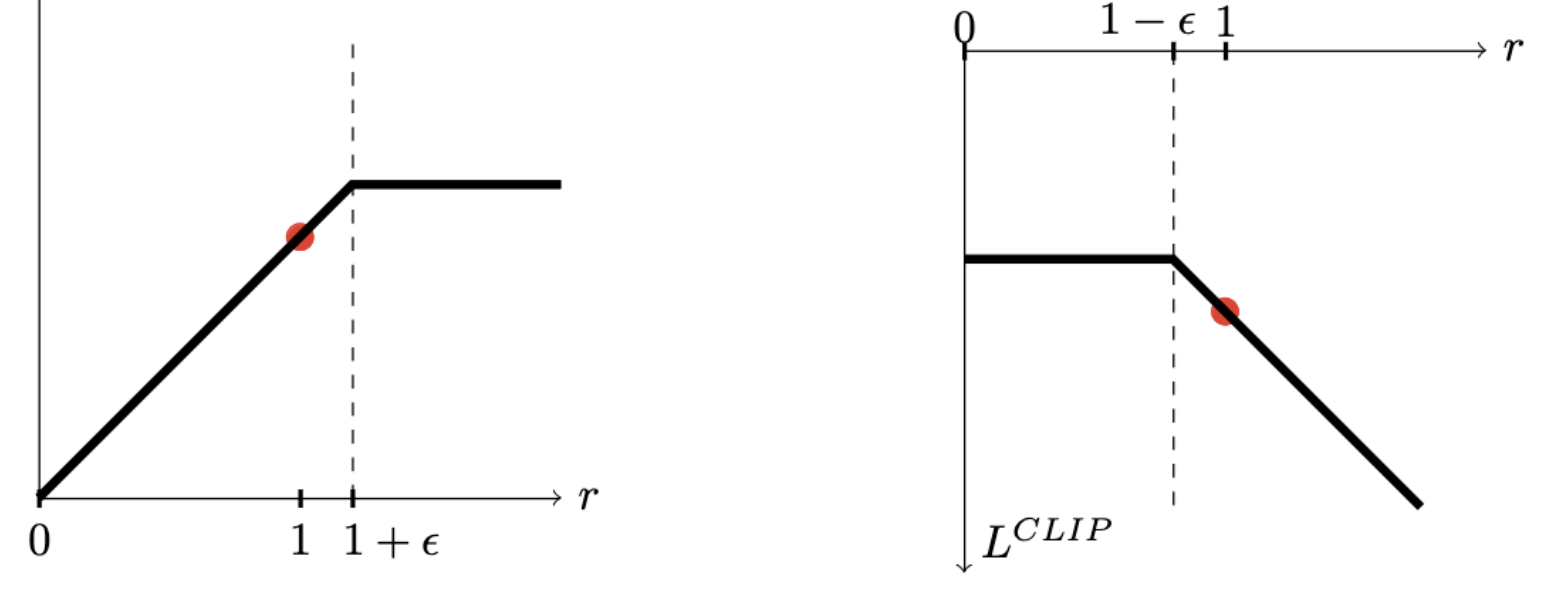
Now we introduce the surrogate objective of TRPO. Here $E_{s,a \sim \pi_{\text{old}}}$ means sampling a trajectory from the old policy and then a timestep uniformly from $0,\ldots,H$; states and actions are therefore weighted by their visitation frequency. For the finite-horizon setting, we understand the timestep to be part of the state so that the advantage accounts for the remaining horizon.
$$L(\theta) = E_{s,a \sim \pi_{\text{old}}} \left[ \frac{\pi_\theta(a | s)}{\pi_{\theta_{\text{old}}}(a | s)} A^{\pi_{\text{old}}}(s,a)\right]$$
$$\max_\theta L(\theta) \quad \text{s.t.} \quad E_{s \sim \pi_{\text{old}}} \left[ KL\left(\pi_\theta(\cdot|s) \,||\, \pi_{\theta_{\text{old}}}(\cdot|s)\right)\right] \leq \delta$$
Why does this surrogate have the same gradient direction as the true objective at the old policy? When differentiating, we hold the old-policy sampling distribution, the denominator, and the advantages fixed:
\[
\begin{align*}
\nabla_\theta L(\theta)
&= E_{s,a \sim \pi_{\text{old}}} \left[ \frac{\nabla_\theta \pi_\theta(a|s)}{\pi_{\theta_{\text{old}}}(a|s)} A^{\pi_{\text{old}}}(s,a)\right] \\
\left.\nabla_\theta L(\theta)\right|_{\theta=\theta_{\text{old}}}
&= E_{s,a \sim \pi_{\text{old}}} \left[ \left.\nabla_\theta \log \pi_\theta(a|s)\right|_{\theta=\theta_{\text{old}}} A^{\pi_{\text{old}}}(s,a)\right] \\
&= \frac{1}{H+1}\left.\nabla_\theta U(\theta)\right|_{\theta=\theta_{\text{old}}}.
\end{align*}
\]
The second line uses $\nabla_\theta \pi_\theta / \pi_\theta = \nabla_\theta \log \pi_\theta$. The last line is the policy gradient formula derived earlier, divided by $H+1$ because we average over timesteps: replace the full return by reward-to-go, take its conditional expectation given $(s,a)$ to obtain $Q^{\pi_{\text{old}}}$, and subtract the state-value baseline to obtain $A^{\pi_{\text{old}}}$. This equality assumes exact advantages; sampled advantage estimates introduce estimation error.
This is a local approximation because the action probability ratio corrects action choices at old-policy states, while leaving the old policy's state visitation distribution unchanged. The gradient agreement up to a positive scale factor gives us the correct local direction, but does not justify an arbitrarily large step. The KL constraint limits changes in action distributions to help keep this approximation reliable. The full TRPO algorithm looks like:
- For each iteration $k = 1, 2, \ldots$ do:
- Run policy for T timesteps or N trajectories
- Estimate advantage function at all timesteps
- Compute policy gradient $g$
- Use conjugate gradient (with Hessian-vector products) to compute $F^{-1}g$
- Do line search on surrogate loss and KL constraint
- End for
- Initialize policy parameters $\theta_0$, initial KL penalty $\beta_0$, target KL divergence $\delta$
- For each iteration $k = 0, 1, 2, \ldots$ do:
- Collect a set of (partial) trajectories $\mathcal{D_k}$ using current policy $\pi_{\theta_k}$
- Estimate advantages $\hat{A}_t^{\pi_{\theta_k}}$ using any advantage estimation algorithm
- Compute policy update: $$ \theta_{k+1} \leftarrow \arg \max_{\theta} \frac{1}{|\mathcal{D}|}\sum_t \left[ \frac{\pi_\theta(a_t|s_t)}{\pi_{\theta_k}(a_t|s_t)} \hat{A}_t - \beta_k \, \bar{D}_{\text{KL}}[\pi_{\theta}(\cdot|s_t) \,||\, \pi_{\theta_k}(\cdot|s_t)\big] \right] $$
- by taking K steps of minibatch SGD (via Adam)
- if $\bar{D}_{\text{KL}}(\theta_{k+1} || \theta_{k}) \geq 1.5 \delta$ then:
- $\beta_{k+1} = 2 \beta_k$
- else if $\bar{D}_{\text{KL}}(\theta_{k+1} || \theta_{k}) \leq \delta / 1.5$ then:
- $\beta_{k+1} = \beta_{k} / 2$
- End for
KL Estimator
Let's first discuss forward and reverse KL.
- Forward KL: $D_{KL} (P || Q) = E_{x \sim P} [\log \frac{P(x)}{Q(x)}]$ where you sample from the true distribution $P$ and see how bad $Q$ (e.g., your model distribution) is at predicting those samples. It penalizes $Q$ heavily when $Q(x)$ is small in regions where $P(x)$ is large, so $Q$ learns to be mode-covering.
- Reverse KL: $D_{KL} (Q || P) = E_{x \sim Q} [\log \frac{Q(x)}{P(x)}]$ where you sample from your model $Q$ and measure how much those samples disagree with the true $P$. It penalizes $Q$ when it puts probability mass where $P(x)$ is small. Intuitively, it's ok for $Q$ to ignore some parts of $P$ entirely, as long as the areas it does cover have high $P(x)$, so $Q$ learns to be mode-seeking.
- $k_1$ estimator: $k_1 = \log \frac{q(x)}{p(x)} = - \log r$. It is unbiased but has high variance: it's negative for half of the samples whereas KL is always non-negative.
- $k_2$ estimator: $k_2 = \frac{1}{2} (\log \frac{p(x)}{q(x)})^2 = \frac{1}{2} (\log r)^2$. Intuitively, $k_2$ seems to be better because each sample tells you how far apart $p$ and $q$ are, and it's always non-negative. Empirically, $k_2$ does gave much lower variance than $k_1$, while also comes with a low bias.
- $k_3$ estimator: $k_3 = (r - 1) - \log r$. To see how we derived this: the motivation is to introduce a control variate in $k_1$ to reduce variance, and we notice $\frac{p(x)}{q(x)} - 1 = r - 1$ has zero expectation so for any $\lambda$, $- \log r + \lambda (r - 1)$ is an unbiased estimator of $KL[q, p]$. Then, notice that if we pick $\lambda = 1$, $(r - 1)$ is exactly the tangent line for $\log(r)$ at $r = 1$; we have $\log r \leq r - 1$ for all $r > 0$ and the expression $(r - 1) - \log r$ measures the vertical distance between the tangent line and $\log(r)$. Empirically, $k_3$ estimator is not only unbiased, but also has low variance.
References:
- Approximating KL Divergence by John Schulman
- Foundations of Deep RL by Pieter Abbeel
- Stanford CS234 by Emma Brunskill